The small print, at normal size
What this is
A 25-question quiz about how your brain behaves, scored across six systems, wrapped in jokes. It takes about four minutes and asks for nothing from you except honesty.
What it isn't
It isn't a screening instrument. It isn't validated against anything. It wasn't written by a clinician and it hasn't been reviewed by one. The questions were chosen because they're recognisable, not because they're diagnostic — those are very different jobs.
This is not a diagnosis, a screening tool, or medical advice. It is a fun quiz made by someone who is not a clinician. Only a qualified professional can assess ADHD.
What the questions actually ask
Mostly they ask what the pattern has cost you, rather than whether you fidget in meetings. The finished thing that never went out. The evening that vanished. How long it takes to get back into something after you put it down — which is the one nobody else seems to ask, and quite possibly the most useful question here.
They also ask about unevenness rather than level. The eleven-hour Saturday where you forgot to eat counts as evidence for the pattern, not against it, which surprises people often enough to be worth saying twice.
How the scoring works
Every question belongs to one of six systems. Each answer is worth 0–4, a couple of questions are reverse-scored to catch autopilot answering, and each system is turned into a 0–100 score. Your overall number is the average of those six — so a big spike in one area doesn't get buried by four calm ones.
- The Attention Span — Not how much attention you have — you have loads. Where it goes, and who decided.
- The Filing System — Every system you have ever set up, and the exact Thursday each one died.
- The Clock — Time blindness, deadline adrenaline, and what that extra hour actually cost you.
- The Cold Start — How much of Monday goes on working out where Thursday left you.
- The Engine — What actually makes you go, and how little of it turns out to be willpower.
- The Last 10% — The graveyard of nearly-done things, and the bill nobody ever adds up.
What happens to your answers
They're sent to the server, scored, and immediately thrown away. There's no database and no account, so there is nothing to look up later, nothing to leak and nothing to sell. Your answers get packed into the result link itself — that's why it's long and looks like nonsense. Close the tab and it's gone. Keep the link and you keep the result.
Two honest caveats, because a page like this should be specific rather than smug. Because your answers travel inside the URL, they will appear in ordinary web-server logs the way any other address does. And the site uses Google Analytics to count visitors, which sets a cookie and tells me how many people arrived and roughly from where — not who they are, and not what they answered.
Why I made it
I have never been assessed. I'm not on a waiting list, I've never taken medication for any of this, and I genuinely don't know whether I'd meet the criteria if I ever sat down in front of someone qualified to say.
What I do have is the bill. Eighteen years of product and design work, delivered on deadline, for clients who would have noticed immediately if it hadn't been. And running quietly alongside it: nine songs released and more than forty abandoned. A plugin that took two years of calendar time and a fraction of that in actual work. Something I finished, properly finished, and then left sitting for six months until the moment for it had passed. Three separate planning documents for the same job, written months apart, not one of them acted on.
Same person. Same skill. Same work ethic. The only variable that ever moved was who was holding the deadline.
For about a year I treated do I actually have this? as the question I had to settle before I was allowed to do anything about it. I don't think that any more. Nobody is processing applications, and deciding you're not bad enough to count doesn't let you off — it just quietly removes the only explanation available that isn't about your character.
What actually changed things was small enough to be embarrassing. I took one of these quizzes. It wasn't a good one. And the part that landed wasn't the score at the end, which I barely looked at — it was the questions, and the specific sensation that whoever wrote them had been following me around.
So that's what this is trying to be. Not an answer. Just the questions, asked properly, and funny enough that you'll actually reach the end of them.
If you want the real thing
Start with your GP, or look up a psychiatrist or clinical psychologist who assesses adult ADHD. National ADHD organisations usually publish a list of who's legitimate in your country, and that list is a much better use of your afternoon than this website. Routes and waiting times vary enormously by country, so it's worth ten minutes finding out which ones exist where you are — the difference between them can be years rather than weeks.
Three things that make that first appointment go better, none of which are my ideas:
Write the specifics down and take them in. Not a description of how you feel, which is hard to produce under pressure and easy to wave away. The actual items, and what each one cost you.
Bring whatever you can get from childhood. School reports, or a parent or older sibling who remembers what you were like. This is often the part that decides the outcome and the part you can't improvise in the room.
Take someone with you if you can. Not for moral support. Because you will sit there being reasonable and articulate and you will underplay the whole thing, and somebody who has watched you up close for years will say the bit you were about to leave out.
You may also come across the ASRS or the WURS. Those are validated screening questionnaires and they are a different class of object from this quiz. They are still not a diagnosis: a screen sorts people into worth-looking-at and probably-not, on the strength of what you say about yourself. A diagnosis is someone trained to do it examining your history, ruling out the other things that produce this same picture, and taking responsibility for the answer.
And if it doesn't go well — if you're told your grades were too good, or that you seem to be coping — a short appointment is not the last word, and second opinions exist. It also changes nothing about the bill. Whatever you were told in that room, you still have to work on Monday.
There's a book, too
All of the above is the short version of an argument I ended up making at length. Bad Enough: ADHD or Not? — What to do before you know — is about what to do in the meantime: while you're undiagnosed, possibly staying that way, and still expected to get work done on Monday.
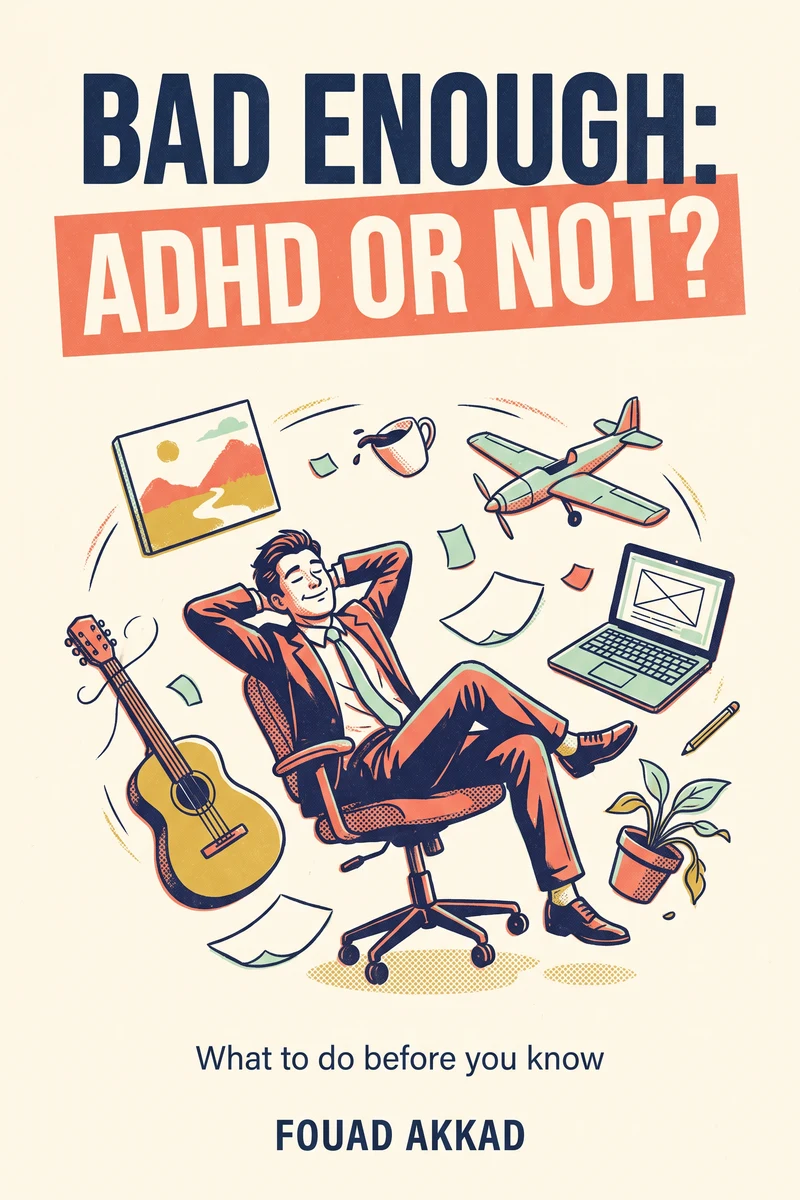
Each of the six systems further up this page has a chapter behind it — the bill you never added up, why every organising system you built died, and what it actually costs you to pick something back up on a Monday morning.
It is not a substitute for the section above this one, and it doesn't pretend to be. It's for the wait.
Get Bad Enough: ADHD or Not?Free, or pay what you like. About an evening to read.